




The W&H Way to Craft an Influential Story

August 19, 2024

Inevitably, at some point during our Influential Storytelling workshop, either Stephanie or Kara will say, “Storytelling is both an art and a science.” As we stand there in front of a room of professionals interested in developing their storytelling skills, we are always reminded of how important it is to hold both truths at once..


Storytelling is an art. It’s human. It’s not technical or linear. It’s how we think. It’s who we are. It is a form of expressing oneself authentically.

Storytelling is also a science. It can be studied. There are proven qualities of a story that have predictable results. In particular, there are frameworks and a process you can follow to craft an influential story.


Our goal is to help people dance between these two aspects of storytelling. The process and frameworks are there to ground you and help you begin from where you are. And then we also encourage you to notice your instincts, your natural inclinations, your context and environment and let that inform your storytelling as well.


When we’re in a room facilitating the workshop and some curious, some excited, some skeptical faces are looking at us, we have the ability to lead the dance. Here is our attempt to write it all down. It’s somewhat linear, somewhat flexible, and will get you started if you want to be an influential storyteller.


The Wolf & Heron Influential Storytelling Process


Crafting an influential story is tough. Where do you start? What do you do along the way? How do you know if and when you’re ready to share your story? We thought it would be fun to try to lay out our process from beginning to end. During our  Influential Storytelling program, we take participants through the entire process of crafting an influential story, but it’s something else to see it laid out on a page. Let’s see if we can do it!


1. Think of a story idea.


Once you have the time, place and need for a story, you have to choose a story idea. Story ideas can come from anywhere. As a practice, we recommend developing a habit of periodic reflection to take note of the stories that you’ve lived as you live them. Threshold moments—when there’s a major transition in your life or work—are great opportunities for reflection. When a project closes out, a birth, a death, a new job, a new boss… all these moments can serve as opportunities for you to think about where you’ve been, where you are, and where you’re going. Take note of any times when you have strong emotional reactions to things, or evolve your thinking on something. All these moments can eventually turn into stories that you can leverage when the opportune moment presents itself.


2. Block out your story.


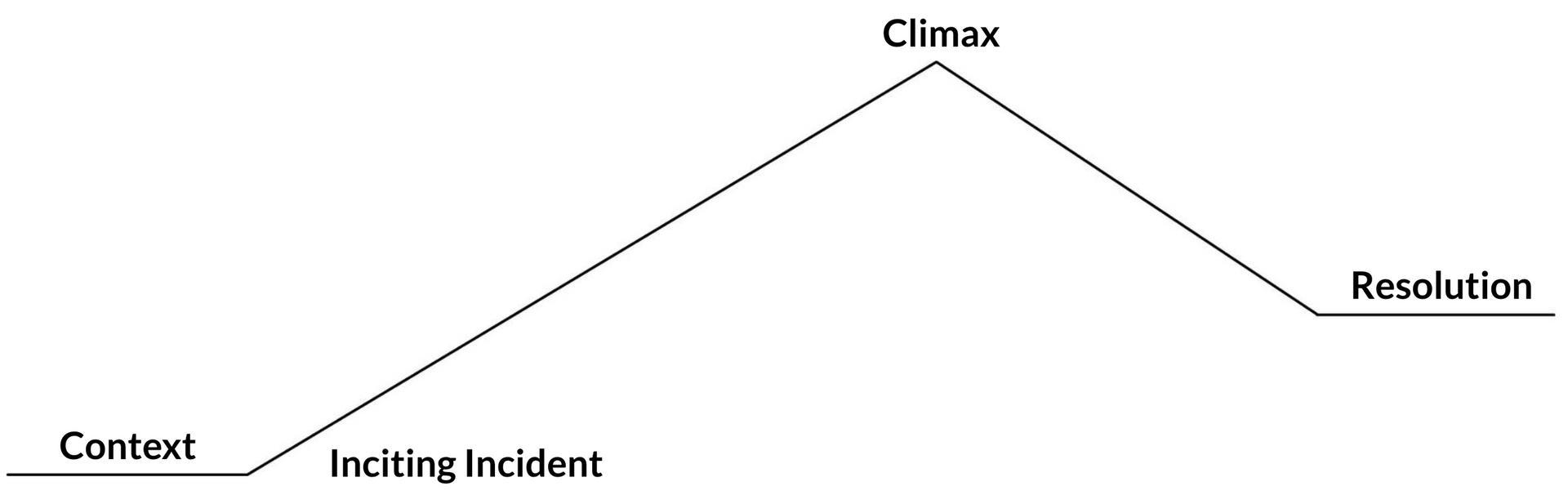
Once you have the story idea, the next step is to block it out and shape it into story form. By putting pen to paper (or text to google doc), you will make sure that your story is a story and not just a high-level description of what happened. Keep in mind that all stories have at least one character, and follow this basic story structure:


For a deeper explanation of this structure, check out this article


For each building block, fill in what happened. Focus on a few things: 


  • What happened: The events (the plot).
  • Why it matters: The stakes, why you cared, why others cared, the potential risks and impacts.
  • Time and place: When it took place and where.
  • Sensory details: What did you see, hear, smell, feel? 


Additionally, to really lean into the power of story, you’ll also want:


  • Specificity: The more “in the scene” you can be with respect to characters, setting, actions, thoughts, sensory details, etc. the more visceral and cinematic your story becomes. This is what makes your story experiential, and therefore memorable.
  • Transformation: Something needs to be different at the end than it was at the beginning. Usually this is your main character.


3. Share your story


Once you have a few notes blocked out on your story arc, it’s time to start telling your story. At first, find low-risk audience members and simply try to get your story out. Have an audience member reflect back to you what they heard, what worked, and what needs working on. This step will move you leaps and bounds towards a more refined story than any sitting at your desk alone in a dark room ever will.


4. Apply the Super Powers.


Once you have your story blocked out, you have a story but it still needs work to refine and make it compelling. Not all stories are created equal, and if you want to ensure your story is truly influential, you will need to focus on each of the four “super powers” and pull them through your story. Looking for a summary of all of the Super Powers? See here.


Keep it Real - Be authentic

Engage Emotion - Make your story a physiological and emotional experience

Invite Curiosity - Use mystery and suspense to make your story an intellectual experience

Pick One Theme - Focus on a single message


5. Write it down in full sentences.


At some point in this process, take the time to write down your story. And not just in bullet points, but in full sentences. The reason is that in writing a few things happen - you’ll realize and capture more details than you thought you had, and it will force you to clarify your thinking and be more specific. This also gives you the opportunity to have something to edit going forward. Once you have the draft, you can go back and refine via the other steps.


6. Plan your delivery approach.


It’s important to consider not just what you say, but how you say it. Your delivery, your voice, your gestures and body movement, all play a role in amplifying the meaning of your story, and in particular, adding emotion and interest. You can view the 5 Ps of Delivery here.


Additionally, consider your blocking. This is theater-speak for knowing when and where you will take a step or two, how you will move your arms, where you will look, etc. Your body is as much a part of your communication (in fact, it’s even more important) as what you say verbally.


7. Practice your story. Again.


The more that you share your story with others, the more insight you will gain into the effectiveness and impact of your story. Use your written story as a guide and actually read it aloud.  Sharing your story with feedback partners allows you several small wins. It helps you: 


  • Build your emotional and mental confidence in sharing your story. 
  • Vet your story for confusing sequencing or unnecessary details. 
  • Collect feedback on your use of the 4 super powers and 5 Ps. 


When asking for feedback, you can always use the feedback guides included as part of the Influential Storytelling experience, or you can keep it simple and consider these questions: 


  • What is the main takeaway you have from the story? 
  • What might make the story more powerful? 
  • What could I leave out without impacting the power of the story? 


After receiving feedback, be sure to revise your draft. Capture the ideas and suggestions others give you, check them against what feels authentic to you, and integrate them into your story in a way that feels real.

The story crafting process is messy. Sometimes it can feel like you have to take three steps backward just to find a way forward again. That’s the art side of the journey. But if you stick at it, and keep iterating, you will find your way to a story that’ll be not only entertaining, but influential.

Storytelling is an art. It’s human. It’s not technical or linear. It’s how we think. It’s who we are. It is a form of expressing oneself authentically.

Storytelling is also a science. It can be studied. There are proven qualities of a story that have predictable results. In particular, there are frameworks and a process you can follow to craft an influential story.

Our goal is to help people dance between these two aspects of storytelling. The process and frameworks are there to ground you and help you begin from where you are. And then we also encourage you to notice your instincts, your natural inclinations, your context and environment and let that inform your storytelling as well.

When we’re in a room facilitating the workshop and some curious, some excited, some skeptical faces are looking at us, we have the ability to lead the dance. Here is our attempt to write it all down. It’s somewhat linear, somewhat flexible, and will get you started if you want to be an influential storyteller.

The Wolf & Heron Influential Storytelling Process

Crafting an influential story is tough. Where do you start? What do you do along the way? How do you know if and when you’re ready to share your story? We thought it would be fun to try to lay out our process from beginning to end. During our  Influential Storytelling program, we take participants through the entire process of crafting an influential story, but it’s something else to see it laid out on a page. Let’s see if we can do it!

1. Think of a story idea.

Once you have the time, place and need for a story, you have to choose a story idea. Story ideas can come from anywhere. As a practice, we recommend developing a habit of periodic reflection to take note of the stories that you’ve lived as you live them. Threshold moments—when there’s a major transition in your life or work—are great opportunities for reflection. When a project closes out, a birth, a death, a new job, a new boss… all these moments can serve as opportunities for you to think about where you’ve been, where you are, and where you’re going. Take note of any times when you have strong emotional reactions to things, or evolve your thinking on something. All these moments can eventually turn into stories that you can leverage when the opportune moment presents itself.

2. Block out your story.

Once you have the story idea, the next step is to block it out and shape it into story form. By putting pen to paper (or text to google doc), you will make sure that your story is a story and not just a high-level description of what happened. Keep in mind that all stories have at least one character, and follow this basic story structure:

For a deeper explanation of this structure, check out this article

For each building block, fill in what happened. Focus on a few things: 

  • What happened: The events (the plot).
  • Why it matters: The stakes, why you cared, why others cared, the potential risks and impacts.
  • Time and place: When it took place and where.
  • Sensory details: What did you see, hear, smell, feel? 

Additionally, to really lean into the power of story, you’ll also want:

  • Specificity : The more “in the scene” you can be with respect to characters, setting, actions, thoughts, sensory details, etc. the more visceral and cinematic your story becomes. This is what makes your story experiential, and therefore memorable.
  • Transformation : Something needs to be different at the end than it was at the beginning. Usually this is your main character.

3. Share your story

Once you have a few notes blocked out on your story arc, it’s time to start telling your story. At first, find low-risk audience members and simply try to get your story out. Have an audience member reflect back to you what they heard, what worked, and what needs working on. This step will move you leaps and bounds towards a more refined story than any sitting at your desk alone in a dark room ever will.

4. Apply the Super Powers.

Once you have your story blocked out, you have a story but it still needs work to refine and make it compelling. Not all stories are created equal, and if you want to ensure your story is truly influential, you will need to focus on each of the four “super powers” and pull them through your story. Looking for a summary of all of the Super Powers? See here.

Keep it Real - Be authentic

Engage Emotion - Make your story a physiological and emotional experience

Invite Curiosity - Use mystery and suspense to make your story an intellectual experience

Pick One Theme - Focus on a single message

5. Write it down in full sentences.

At some point in this process, take the time to write down your story. And not just in bullet points, but in full sentences. The reason is that in writing a few things happen - you’ll realize and capture more details than you thought you had, and it will force you to clarify your thinking and be more specific. This also gives you the opportunity to have something to edit going forward. Once you have the draft, you can go back and refine via the other steps.

6. Plan your delivery approach.

It’s important to consider not just what you say, but how you say it. Your delivery, your voice, your gestures and body movement, all play a role in amplifying the meaning of your story, and in particular, adding emotion and interest. You can view the 5 Ps of Delivery here.

Additionally, consider your blocking. This is theater-speak for knowing when and where you will take a step or two, how you will move your arms, where you will look, etc. Your body is as much a part of your communication (in fact, it’s even more important) as what you say verbally.

7. Practice your story. Again.

The more that you share your story with others, the more insight you will gain into the effectiveness and impact of your story. Use your written story as a guide and actually read it aloud.  Sharing your story with feedback partners allows you several small wins. It helps you: 

  • Build your emotional and mental confidence in sharing your story. 
  • Vet your story for confusing sequencing or unnecessary details. 
  • Collect feedback on your use of the 4 super powers and 5 Ps. 

When asking for feedback, you can always use the feedback guides included as part of the Influential Storytelling experience, or you can keep it simple and consider these questions: 

  • What is the main takeaway you have from the story? 
  • What might make the story more powerful? 
  • What could I leave out without impacting the power of the story? 

After receiving feedback, be sure to revise your draft. Capture the ideas and suggestions others give you, check them against what feels authentic to you, and integrate them into your story in a way that feels real.

The story crafting process is messy. Sometimes it can feel like you have to take three steps backward just to find a way forward again. That’s the art side of the journey. But if you stick at it, and keep iterating, you will find your way to a story that’ll be not only entertaining, but influential.

Share this article

Recent Posts

By Stephanie Judd March 2, 2026
Many of the people we coach are people leaders who are stressed about supporting their people in the midst of (massive) organizational change. Then pile on the fact that they’re often losing resources and being asked to do more with less. We hear comments like: I don’t know what to tell my team that will be helpful when I’m frustrated and overworked myself. Leadership just keeps asking for more. How do I keep them motivated? We don’t have any professional development money for them. These leaders think that they have to show up with the answer to everyone else’s problems. They want to be able to provide a solution that will give their teams clarity and direction. They know that’s what their people want. And yet, they’re often ignoring the most critical tool in their arsenal.
By Stephanie Judd February 16, 2026
Last week, Kara coached Carl, a leader who was getting ready for a working group meeting. It was the group’s first opportunity to meet after their kickoff, and a critical moment to move the group from idea to action. Carl was concerned that people would be reluctant to contribute and then he’d be left alone to do the work without the crucial input from his stakeholders. What Carl needed was some space to get clear on the desired outcomes of his meeting, think through how he was going to run it, and make sure everyone was set up to contribute meaningfully. By the end of the session, Carl felt ready. You can’t prepare to the same degree for all your meetings. Sometimes all you can do is make sure you have a Zoom link attached to the calendar invite. But for high-stakes moments, the discussions that truly matter and require input from others, you need to go further and approach them strategically. That is one of the clearest ways you demonstrate leadership.
By Stephanie Judd February 3, 2026
One of the most frustrating things Stephanie and Kara experience is facing a meeting on their calendar with a vague title and no agenda. Or (let’s be honest, it’s not much better) the laundry list of topics masquerading as an agenda. When looking at these meetings, Stephanie and Kara don’t know what’s expected of them, how to prepare, nor what the point of the meeting is at all. But… although we’re all victims of this workplace crime… we’re also the perpetrators. Just last week Kara titled a meeting “Storytelling Kickoff” that didn’t have an agenda. Stephanie created a calendar invite titled “Call with Lynette.” It too, had no agenda. We were both invited to a blank “Connect.” Stephanie even registered for a webinar months ahead of time, but when the day came, the calendar invitation title was “Webinar” with no description or agenda, so of course she didn’t attend.
January 19, 2026
Earlier this month, we talked about why data can be difficult to communicate . Data often lacks meaning, is hard to process, and rarely engages people emotionally. Fortunately, there’s a way to address all three challenges at once. Storytelling is one of the most effective ways to make your data more compelling. Here’s why.
Show More