


5 Tips for Planning an Interactive Session

July 29, 2024
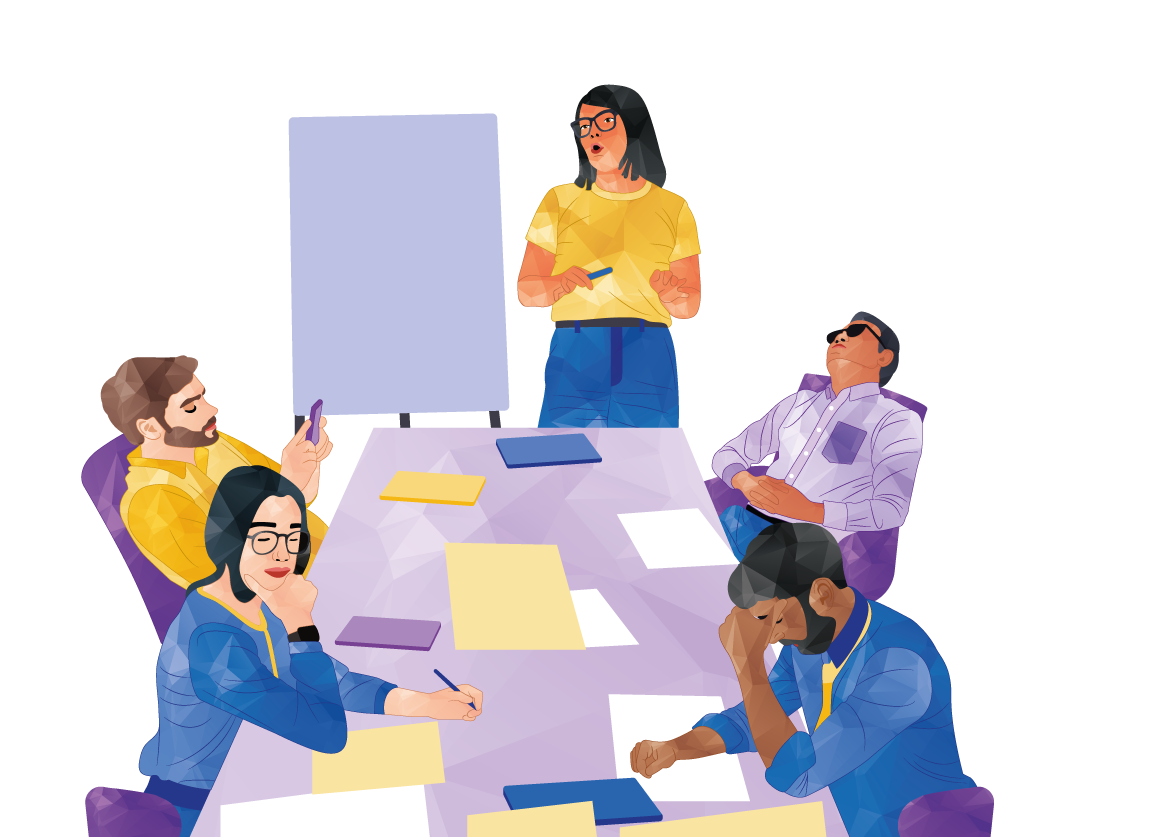
A presenter in yellow shirt and sunglasses points at a chart during a meeting. Others sit at a table.

Big meetings and events are due for a refresh. As an example, Melissa was planning an all-company retreat for her 150-person organization. This is a once-a-year event where the entire organization gathers for a few days. Typically the time is spent reviewing the year that just happened, and launching the strategic initiatives of the year to come. We see similar formats with sales kickoffs, leadership retreats, and even some conferences.


Now, Melissa had read our article that we recently published recommending that presentations aren’t always the best way to go… especially when what you want is engagement. She decided to challenge herself and the planning team to rethink their approach and reduce the number of presentations that were typically delivered during this retreat, and instead deliver the content of the retreat in a more interactive, and engaging way.

She decided to focus her efforts on the breakouts. At a few moments in the flow, the 150-person group would break into smaller sessions. Given the more intimate nature of these sessions, she thought these would be where she could do some experimentation in terms of the delivery strategy. And so she reached out to us.


It is through our work with people like Melissa that we have identified some common mis-steps when it comes to planning interactive sessions, so we thought we’d bring them to you. If you’re looking to leave the presentation behind and design a more engaging session for your audience, here are 5 tips to consider.


Less is more


If you’re planning to turn a breakout into an interactive session, the first mistake people make is that they expect to cover the same amount of content they would have covered if it was a presentation. In the course of a presentation, a speaker can cover a decent amount of ground, but when it comes to an interactive session, the same amount of content is simply too much. For your audience to truly process, contextualize, and integrate the content, you have to go a bit slower so you have more space for exploration and interactivity.


But there’s good news! There’s a disconnect between how much content is covered during a presentation and how much the audience actually remembers. The most generous studies out there suggest that audiences remember only 10% of the content from a 10-minute presentation just one week after the event. The numbers drop even lower as the length of the presentation increases. Interactive sessions, by their very nature, are more effective at driving retention, in addition to other intangibles like buy-in, motivation, and commitment. Even though you cover less, you’ll have stronger and longer-lasting outcomes.


So how much can you cover? The general rule of thumb is to multiply your presentation time by 3-4. That means a 15-20 minute presentation can be effectively covered in a 1-hour interactive session.


Follow the Setup-Activity-Debrief cycle


A best practice of interactive sessions is to follow a cycle where the facilitator sets up an activity, breaks the room up into smaller groups to do the activity, and then debriefs the activity as a room again. Staying true to this cycle maximizes the interactive nature of the experience (and therefore retention and buy-in) and minimizes the burden on the facilitator to be a content expert themselves. This is a tried and true go-to approach to structuring your interactive sessions.


Transitions take time


Interactive sessions require transitions. The group will move from a facilitator-led room discussion to an individual or pair activity, to a table discussion, and so on. These transitions are not nothing. In fact, it’s often these transitions that derail an otherwise well-planned session.

As a general rule of thumb, plan for 2-5 minutes to transition to and set up an activity. This gives the facilitator time to orient the group to the materials, help them understand the task they need to complete, answer any questions they may have, and give them time to settle into the work. Once an activity is complete, plan 3-5 minutes for each debrief question you plan to have the facilitator ask, and give it even more time if the group is large. All together, that means a 10-minute table discussion will eat up 15-20 minutes of your agenda time. Plan these transitions in, or you’ll be behind schedule almost immediately, and have no way of recovering the time.


Have a Plan B and C, and consider your edge cases


If you plan to break the room into pairs for an activity, make sure you know what to do with the odd man out… will that person work alone? Or join a pair and make a triad? If the triad is given the same amount of time to work through the activity, will it be enough? These questions are important to consider, and can have a huge impact on the participants’ experience.


But outside of edge cases, Plans B and C are important to have on hand. If your tech fails, what will you do? If the printed materials end up printing wrong, how will you manage? What if you ask a question and no one has an answer? Will you jump in with the answer or hang onto silence until someone speaks up? If you need a volunteer, what will you do if no one raises their hand? What will you do if everyone does?


Good facilitators have a plan for the most likely situations BEFORE they get into the room. This helps the experience run smoothly, and gives the participants the impression that all is running according to plan (whether or not it is). This matters because if the audience is worried about the logistics or distracted by questions on mechanics, they’re not focused on the content or conversation.


Debrief questions shouldn’t require much thinking


After a breakout activity, it’s typical for the facilitator to bring the room back together to discuss the activity and land the learning. It’s key to remember that a debrief should NOT require your audience to do any new or additional processing work. The questions you ask in your debrief should have answers the audience has already generated, either through their small-group discussions or via an individual activity. Net new questions require additional processing time, which deflates the energy of the group and slows down the pace of your workshop. Additionally, when the facilitator throws new questions at the audience when they’re in their most vulnerable state—in front of the entire room—the psychological safety of the room is destroyed, and audience members retreat into themselves and the anonymity of the group.


Those are some of the tried-and-true strategies we use when designing workshops, breakout sessions, and any kind of interactive experience. What other rules of thumb do you keep in mind?


Share this article

Recent Posts

By Stephanie Judd February 16, 2026
Last week, Kara coached Carl, a leader who was getting ready for a working group meeting. It was the group’s first opportunity to meet after their kickoff, and a critical moment to move the group from idea to action. Carl was concerned that people would be reluctant to contribute and then he’d be left alone to do the work without the crucial input from his stakeholders. What Carl needed was some space to get clear on the desired outcomes of his meeting, think through how he was going to run it, and make sure everyone was set up to contribute meaningfully. By the end of the session, Carl felt ready. You can’t prepare to the same degree for all your meetings. Sometimes all you can do is make sure you have a Zoom link attached to the calendar invite. But for high-stakes moments, the discussions that truly matter and require input from others, you need to go further and approach them strategically. That is one of the clearest ways you demonstrate leadership.
By Stephanie Judd February 3, 2026
One of the most frustrating things Stephanie and Kara experience is facing a meeting on their calendar with a vague title and no agenda. Or (let’s be honest, it’s not much better) the laundry list of topics masquerading as an agenda. When looking at these meetings, Stephanie and Kara don’t know what’s expected of them, how to prepare, nor what the point of the meeting is at all. But… although we’re all victims of this workplace crime… we’re also the perpetrators. Just last week Kara titled a meeting “Storytelling Kickoff” that didn’t have an agenda. Stephanie created a calendar invite titled “Call with Lynette.” It too, had no agenda. We were both invited to a blank “Connect.” Stephanie even registered for a webinar months ahead of time, but when the day came, the calendar invitation title was “Webinar” with no description or agenda, so of course she didn’t attend.
January 19, 2026
Earlier this month, we talked about why data can be difficult to communicate . Data often lacks meaning, is hard to process, and rarely engages people emotionally. Fortunately, there’s a way to address all three challenges at once. Storytelling is one of the most effective ways to make your data more compelling. Here’s why.
January 5, 2026
Recently, a product manager came to Kara looking for coaching on her storytelling skills and presentation delivery. When Kara asked what was behind the need, the client shared that she often has high-stakes moments with leadership where she needs to secure critical resources, like headcount. These conversations have serious implications for her team and her product’s success. She knows her data inside and out. The decision she wants to recommend to her executives feels clear to her. She’s prepared… but when she walks into the meeting, her data doesn’t land, and her arguments fall flat.  She knows this because leadership asks questions like: What does this number mean? How do you know? They aren’t seeing the context, the “so what,” or how her data fits into the bigger picture of the business.
Show More