


Making Meetings Work: Design to Engage Everyone, Every Time

November 17, 2025

1. Let the Group Do the Work

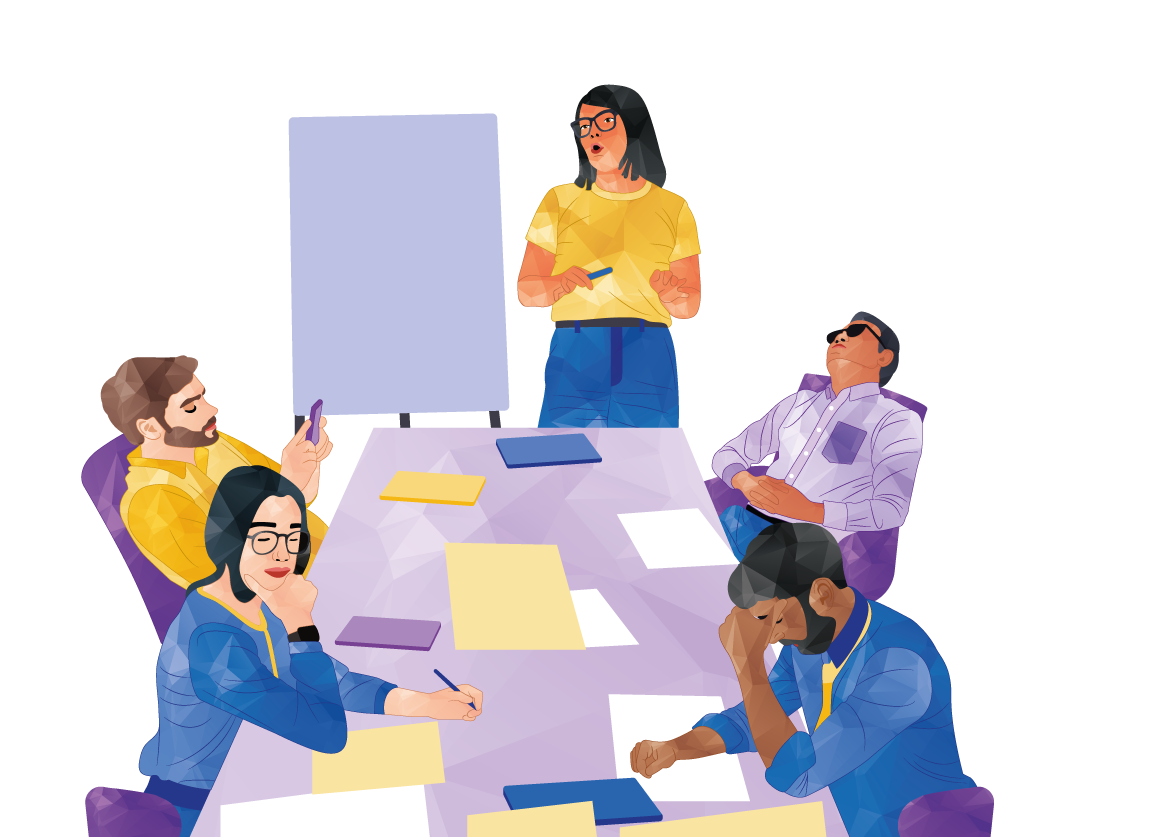
If you’re talking for more than half of your meeting, you’re not facilitating, you’re performing. And performance rarely leads to engagement.


The simplest way to invite participation is to stop answering every question yourself. Stop presenting as if the goal is to prove you’ve done your homework. Your audience doesn’t need more polished slides; they need structured space to think, discuss, debate, and generate.


Instead of an open Q&A (where extroverts take over and everyone else hides), shift to structured small-group discussion. Two to four people at a time. Specific prompts. Clear time limits. A focused debrief at the end.


When the group processes the ideas themselves, three things happen:

  • You get better ideas.
  • You get broader ownership.
  • You get momentum that survives the meeting.


When in doubt? Talk less. Facilitate more.

2. Start Small to Build Psychological Safety

People don’t jump from silence to bold contribution. They need to get comfortable and warm up first.


If you want participation, start with low-stakes asks, e.g. short pair-shares, written reflections, anonymous inputs. As confidence grows, increase the ask. This is why our Ramp Up the Ask guide works so well. It helps you design a participation arc that meets the group where it is and brings them along safely.


Carissa understood this instinctively: leaders started by responding to simple questions on the wall before moving into deeper prompts.


Small steps give you the potential to go big.

3. Ditch the Deck

Slides encourage one behavior above all: talking at people. And when you talk at people, they stop thinking for themselves (and check out mentally).


If the goal is alignment, decision-making, or insight gathering, try something else:

  • A question printed at the top of a poster.
  • A handful of sticky notes.
  • A template small groups fill in together.


These tools force engagement. People move, write, point, debate. They become actors instead of an audience.

Our Materials for Meeting Success guide offers dozens of simple alternatives that spark interaction and avoid the monologue.

4. Use Visual Scaffolding to Give Structure

Posters, flip charts, worksheets, and templates do more than make a meeting look organized. They create a shared visual anchor for conversation. They help people externalize their thinking, see relationships, and build on each other’s ideas.


This is exactly how Carissa kept her 15-minute activity tight and focused. Each flip chart acted as a container for thinking, which made the conversation more productive.


Scaffolding doesn’t restrict creativity. It unlocks it because the guidance is focused and people have more time to play.

Stop Performing. Start Facilitating.

The more your group participates, the more they own the work, —and the more likely they are to act on it afterward. You don’t have to be the star of the meeting. You have to be the spark.


What’s one place in your next meeting where you can stop talking and let them engage instead?

Four people seated at a table, one in purple is facing the group, the others are light-skinned and looking at him/her.


Making Meetings Work | A Practical Series for Team Leads and Managers

Most professionals spend hours each week in meetings, yet too many of those hours feel wasted. At Wolf & Heron, we believe meetings should create clarity, connection, and momentum—not frustration. This article is the second installment of a four-part series that helps team leads and managers design and facilitate meetings that actually work.

When Talking More Doesn’t Mean Achieving More

Bonus:

Want help timing discussions and transitions? Join the Wolf & Heron Influence Library and grab all the tools from this article along with plenty more to help you grow your influence. Register for free access and check out the Ramp Up the Ask and Materials for Meeting Success guides.

Share this article

Recent Posts

By Stephanie Judd June 1, 2026
A few weeks ago, Stephanie got on a call with a client she's been coaching for several months. This client, a public health leader who had spent years building a program she believed in, was in tears.  The list of what she was navigating was almost hard to say out loud: federal funding for her department was evaporating. Public trust in the field she'd devoted her career to had cratered in the years since COVID. There was an active measles outbreak demanding her team's around-the-clock attention. The strategic plan she'd helped design was effectively on hold. And in the same week, both her boss and her most trusted employee had resigned, with a hiring freeze in place that meant no one would be coming to help.
By Stephanie Judd May 18, 2026
“Read the room” is common advice in professional settings, especially when people are preparing for high-stakes meetings or working with senior stakeholders. What people usually mean is that they want you to: navigate different audiences well show up professionally and handle complex real-time dynamics with confidence. Most people are told they need to read the room, but the more critical skill is what you do next and how you adapt in the moment when things don’t go as expected.  “Reading the room” is actually much more about how you lead in the moment. As an influential communicator, you must be willing to check in with the group rather than move on. Then, try something different to re-engage people and move the discussion forward.
May 4, 2026
During a coaching call with Kara, a leader shared a “horror” story we can all relate to. In a recent team meeting, they presented a recommendation for a new process that he needed feedback on. The approach was going to shape the direction of a several-month project, so the stakes were high. He walked the group through his thinking, explained the approach, and then turned to the team and asked, “Any thoughts?” And then nothing. The room went quiet, and he paused and looked around, waiting for someone to jump in. No one did, and after a moment, he moved on. The meeting continued, but it felt flat and unproductive, and it was clear that something hadn’t quite worked.
By Stephanie Judd April 20, 2026
Stephanie was coaching a product manager at Google, Marcus, who was preparing to pitch a new health tech idea to his executives. He had done the work. The research was solid. The opportunity was real. And like many strong operators, his instinct was to lead with the facts. During his discovery process, Marcus had interviewed a nurse, Sarah, who shared something surprising: She logged into her system about 100 times per shift. Marcus dug deeper. Each login took about a minute… That’s more than an hour and a half in an 8-hour shift spent just logging in. That’s a compelling data point. But it's not enough.  Data alone doesn’t carry weight unless people feel what it means. So we worked on how he delivered it. We didn't change the numbers. We just changed the experience of hearing them.
Show More