



Your Data Isn’t Landing (and What To Do About It)

January 5, 2026

Three reasons data fails

1. Data lacks context.

Data on its own lacks meaning because it lacks context. If I say global investment in AI reached $189 billion in 2024, it’s meaningless without additional texture. Are we up or down? Is that significant in 2024? What’s the implication? What should you feel about the data?


You can give the number grounding by adding that it’s roughly equivalent to every person in the U.S. spending $600 on AI. You can then suggest the implication: what was once experimental has rapidly become essential infrastructure. Without context, the number itself is meaningless. With it, it becomes powerful.


When it comes to presenting data, every data point needs a clear So What.

2. Data is hard to process.

challenge increases when your audience isn’t as close to the data as you are, or when they’re non-technical.


Numbers aren’t inherently memorable. If you want buy-in or a decision, people need to understand and retain what you’re sharing. You can help that along by sharing a metaphor or walking through the information in bit sized pieces. 

3. Data doesn’t engage your audience emotionally.

Data doesn’t pull at heartstrings. While people like to believe they make purely rational, data-driven decisions, we’re far more likely to gain support and alignment when we engage people emotionally as well. 


When you’re sharing your data, your delivery (facial expressions, body language, projection, etc.) should make it easier for your audience to understand how you want them to feel.

To sum up

  • Get clear on your message and influence objective
  • Add context and meaning that align with your audience and desired outcome
  • Remove the clutter.


Curious about how to cut the clutter and make your data land? Story is one of the most effective ways to bring clarity and meaning to complex information. Join our webinar on January 22, 2026: Cut the Clutter: Turning Complex Data into Compelling Stories.

Four people in casual clothes, one on office chair, others on beanbags, having a discussion.

Share this article

Recent Posts

Nine illustrated video call participants in colorful tiles with reaction icons along the bottom
By Kara Davidson • November 2, 2026
On video, if you’re not talking, you may just disappear. How to build virtual presence that’s still you, with real examples from our coaching.
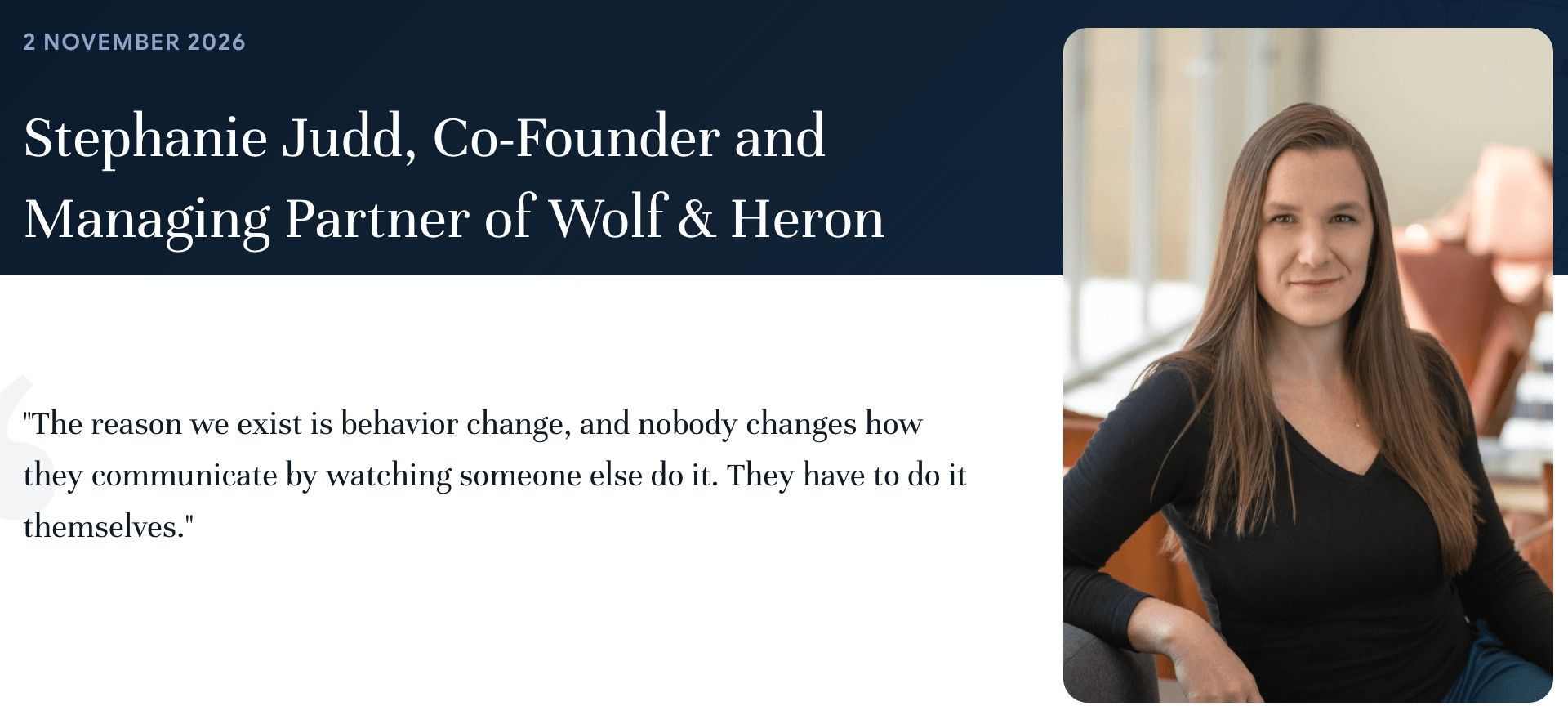
Stephanie Judd interview in The Executive Insight
November 2, 2026
Wolf & Heron co-founder Stephanie Judd talks with The Executive Insight about slide-free training, surviving COVID, and closing the gap between agreement and action.

By Stephanie Judd • October 19, 2026
The first time Stephanie watched Damien work, he had a Palm Pilot in each hand, an earbud in each ear, and apparently half his brain listening to two calls simultaneously. (Yes, that Palm Pilot reference ages Stephanie. She’s aware.) Damien seemed to be everywhere at once, always with something to give. He was also her skip-level boss. His kids were teenagers, and Stephanie was closer in age to them than she was to him. In her first job out of college, he both impressed and terrified her.  So when Stephanie was sent to Ithaca, NY on a recruiting trip to Cornell with Damien, her nerves took over. She saw this two-day trip as an amazing opportunity to build a relationship with him, and she wanted to make sure to impress him with her easy competence and magnanimity. Yes, always the overachiever, Stephanie had a clear vision of how the trip was supposed to go.

By Kara Davidson • October 5, 2026
It's never been more important to be yourself. Kara's brother learned this while hiring for his company. He was eight interviews into a search for a new position at this company, and every one of them wasn’t who they said they were on their resume. Some invented their experience. Others leaned so hard on AI that he couldn't find the actual person behind the answers. He was aggravated trying to figure out what was real and what wasn’t. All he knew for sure was that he couldn’t trust his own read, so he handed the search to a recruiter. That's what happens when people can't tell what's real. They get suspicious of everyone. And when one thing about someone seems off, we doubt the whole person: the experience, the credentials, the firm handshake.
Show More