

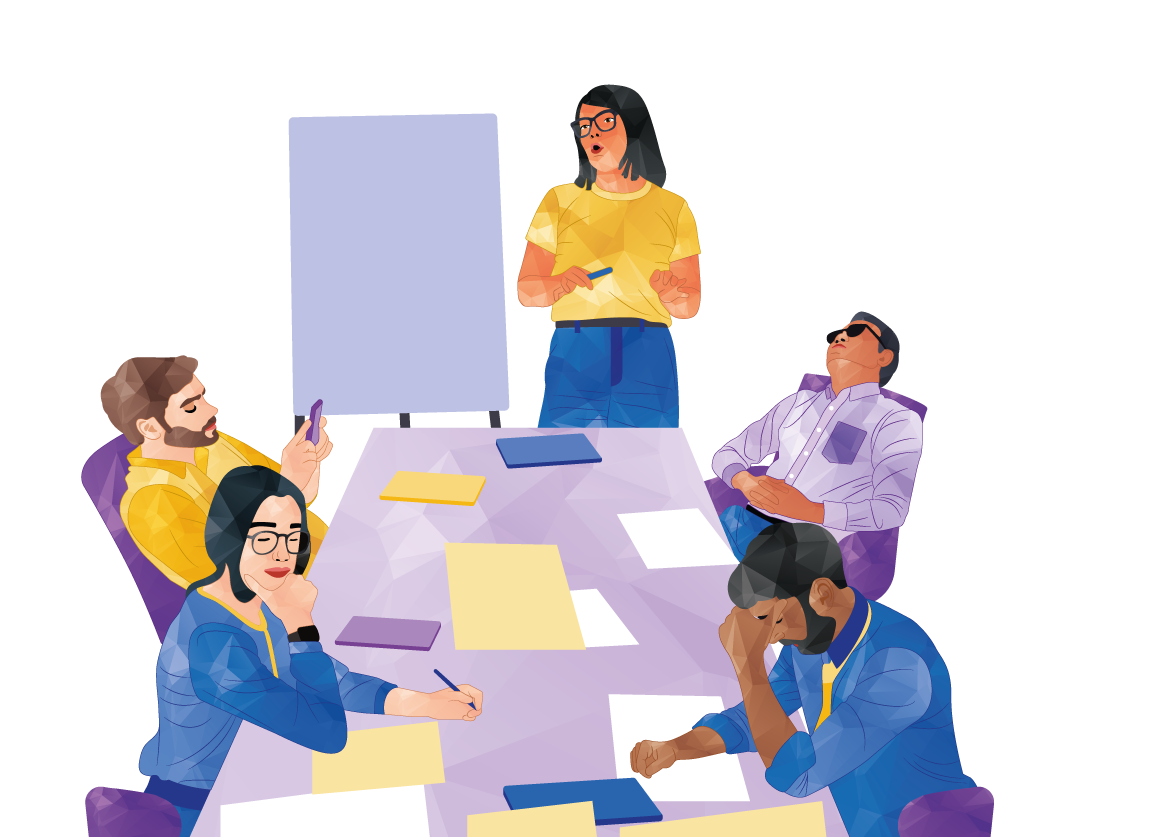

Hearing Crickets? Participation Is Designed
If you’ve ever been a team, project, or working group lead, you can relate. You put all this effort into preparing for the meeting, getting the group together, setting expectations for what you hope to accomplish together, and it ends up falling flat.
The good thing is it doesn’t have to be that way. The most valuable asset in any meeting is the concurrent time of multiple people. Design to take advantage of that. Design a conversation, and you’ll start to see people speak up.
Why Meetings Go Quiet
Most meetings default to presentation mode out of habit. But even when we challenge that habit, we’re often met with fear: What if we encourage a conversation and no one pipes up?
There are several things that can cause silence, and once you have them figured out, you know how to mitigate them. Here are a few common reasons people clam up:
Confusion
Perhaps people are confused. People won’t participate if they don’t know what is expected of them. Often a facilitator’s instructions are too vague or incoherent, or the attendees came in with a different set of expectations for the meeting and now they’re unsure of how to contribute. The fix is clear instructions.
Letitia came to Stephanie stressed. She ran a monthly working group and every month felt the same: low attendance, low engagement, and a Q&A section that was mostly just awkward silence. She spent hours preparing a presentation nobody seemed to care about and couldn't figure out what she was doing wrong.
When Stephanie asked her to walk through the format, Letitia said they do forty minutes of presentation followed by twenty minutes of Q&A. She selected the topic each month, recruited a presenter (often herself by default because no one ever volunteered), and carried the entire session on her back.
Stephanie pointed out something that surprised Letitia, even though it felt obvious to her in retrospect: the format was inadvertently creating a group of observers, not active collaborators. The meeting was designed in a way that encouraged passivity.
Too much too soon
You may ask participants to contribute too much too soon. Asking twelve people on a Zoom call to “share their thoughts” about a new initiative (right after dozing off for thirty minutes while someone presented that initiative) is a large ask. You're asking people to share a personal opinion (read: be vulnerable), on record, in front of colleagues, possibly in front of their boss. The group is NOT ready… and so you get crickets. The fix is to thoughtfully ramp up the asks (otherwise known as “warm up the room”).
Clear Instructions
When your participants are confused, it’s often because expectations are misaligned or vague. The solution is to have excessively clear instructions.
Set Ground Rules
One of the best ways to do this is right off the jump of your meeting, by creating ground rules.
Ground rules tell the group what kind of meeting this is. They help you signal how contributions can be made, that disagreement is welcome, and that the goal is conversation rather than consumption. They also create a shared agreement you can return to if things get uncomfortable.
It’s especially helpful when you think the group has misaligned expectations, it’s a first-time gathering and people don’t know what to expect, or it’s an established routine that you’d like to refresh. A great trick is to establish ground rules in partnership with your attendees to get commitment from the start. Consider questions like:
- How will we show up?
- When should we each provide input?
- How long should we speak before giving someone else the floor?
- How can we kindly and respectfully ask people to get to the point?
- How will we hold each other accountable to these ground rules?
Most facilitators skip this because it feels implied, or slightly awkward to state out loud with a group of adults. Skip it and you spend the rest of the session trying to establish norms that should have been agreed on at the start. When ground rules are set well, the group has already said yes to participating before the first real ask.
Practice Delivering Mechanics
Another trick is to be extremely well-rehearsed on the part of the meeting most people don’t even bother to prepare: the mechanics. If you want folks to break into groups and do something, make sure you know exactly what you want them to do, in what order, and to what level of specificity—and make that all abundantly clear before you send them off to do the activity. Say it once, say it clearly, and then ask if there are questions on mechanics. A good back-up plan is to also have the instructions in written form somewhere for the groups to reference for additional clarity when they need to.
Ramp Up the Ask
Before the meeting, design a way to build the comfort level of the group over the course of the meeting. Start with small asks and work up. For example, begin with intros that are automatic and easily off the cuff. Or, if the group already knows each other, open by asking each person to share a single word that describes how they’re showing up today. Then build to asking them a question where they can share an insight or point of view they already have. End by asking them to debate each other or challenge ideas.
The Ramp Up the Ask (join the Influence Library to get access) guide maps this across three dimensions:
- Who you're asking folks to engage with: a pair, a small group, or the full room. Start with the pair.
- What you're asking them to share: basic information, a prepared opinion, or a personal story. Start with the easy thing.
- How they contribute: writing privately, writing anonymously, speaking seated, or standing up to present. Start with writing.
People are more likely to share if it feels easy. And once you have their participation, you can build on that and earn your way to the harder asks.
What Can Change if You Ditch the Deck
Letitia redesigned her meeting entirely. She built a shared document with structured prompts everyone could write to simultaneously. She stopped presenting and started collecting. The way she designed the meeting required participation instead of setting it up as optional. When she came back to Stephanie the next she shared how stunned she was: people participated, stayed engaged, and left with something they had built together!
In last month's article, you met Clarissa, who took the same approach with a fifteen-minute slot in front of her company's board. She gave them something to generate instead of something to watch, and was invited back. The approach holds at every level, from a working group of twelve to a boardroom.
The conditions for participation have to be designed. Make sure your instructions are painfully clear, and then warm up the room by ramping up the asks, and the active conversation will follow.
Recent Posts