

Three Common Mistakes When Developing a Learning Experience

September 11, 2023

Recently we were hired by a firm that produces an executive education certificate program for Product Leaders. What’s amazing about this program is that it’s for Product Leaders, by Product Leaders; it’s taught by guest faculty members who are themselves high-level executives in the same field. Everything the participants learn is specific and relevant to their context, and they get the benefit of interacting with many proven leaders who have “gone before them,” so to speak. The challenge the firm had was that in the participant feedback these executives—though clearly smart, and experts in their area—weren’t all receiving high marks for their approach to teaching.


Just as not every individual contributor will be a fantastic manager, not every leader will be a fantastic teacher. Fortunately, these are skills that can be developed and there are rules of thumb that can be applied to ensure that content experts can jump into the role of inspiring and engaging a new generation of folks in their area of expertise. 


Here are a few of the common mistakes we see leaders fall into when creating learning experiences.


Too much time presenting


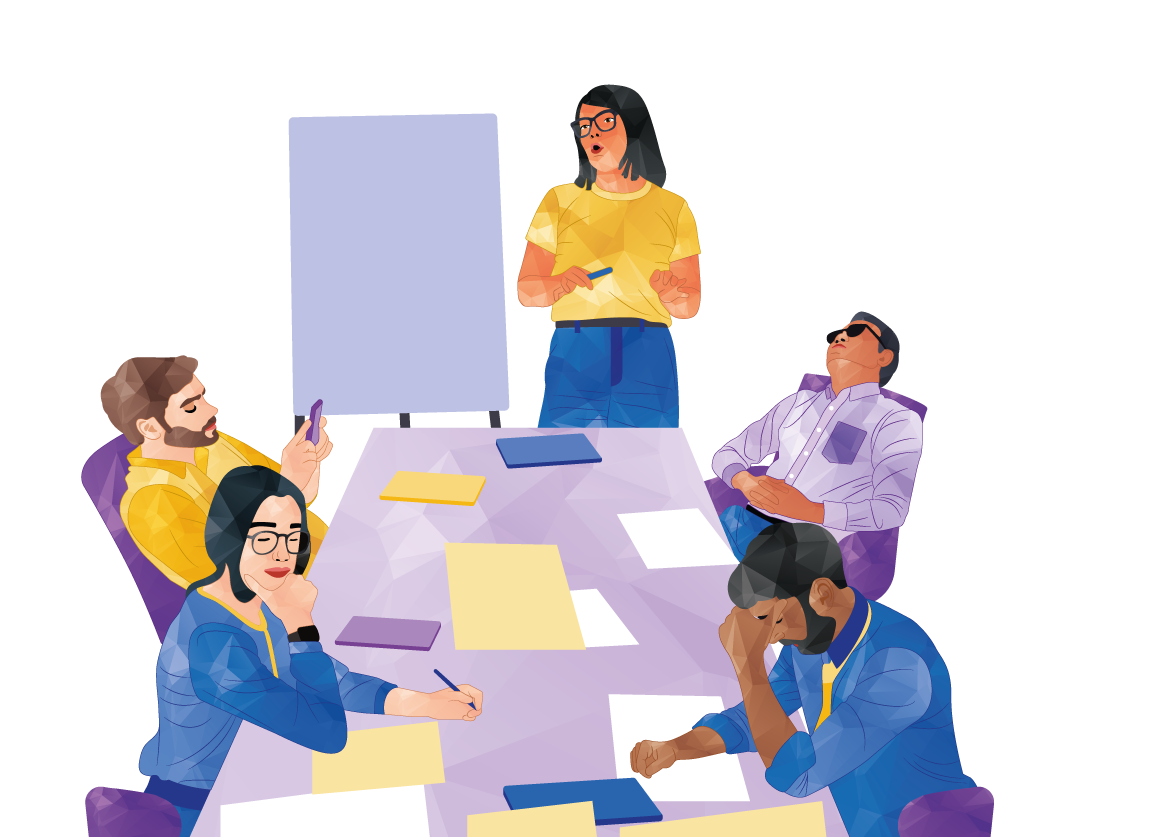
The first inclination many of us have, when developing a learning experience, is to start by building a presentation or lecture. The problem with a presentation is that it is a passive experience for learners. The onus is on each individual learner to wrangle and direct their focus to the presenter… and if the presenter is less than stellar, that can be a tall order. Additionally, presentations are notoriously bad at allowing space for learners to truly process and internalize the information they receive.


Often, the first step away from a pure presentation is to ask the audience a direct question and wait for an answer. This approach suggests a glimmer of interactivity, but all too often, the speaker hears crickets. The group hasn’t been primed to truly engage, and they’re deciding if it’s worth the energy to come up with an answer, let alone offer it aloud. If we’re lucky, we get a few learners willing enough to play that they’ll lob an answer back to the front of the room, but the design of the experience isn’t really set up for true engagement, and it’s easy for learners to multitask or simply zone out.

As much as you can, when designing a learning experience, limit your presentation time. As a rule of thumb, we recommend that if you HAVE to present, do so in bite-sized chunks that are no more than 10 minutes long before switching gears to some form of intentional participant engagement.


Too much information, not enough time to learn it


We’ve all experienced slides that are overloaded with too much text, or so many slides the presenter ends up clicking past several of them. Too much information and not enough time to get through it all is an all-too-common mistake for presenters. But it can also show up in interactive moments of your learning experience. If you set up a 15-minute small group activity that begins with a case study that takes 10 minutes to simply read, you’ll be limiting how well the participants can process that information and do something useful with it before the time is up.


The amount of information an expert wants to share in their area of expertise is infinitely more than what can truly be learned in a concrete and finite amount of time. The key to great workshop design is being crystal clear on what information is important, and what is simply nice to have. The important information is what you build into your materials: your activities, takeaways, etc. The nice-to-have information is what you insert on the fly as facilitator comments if time permits and participants indicate their readiness and curiosity.


Overdependence on a slide deck


Another challenge for content experts who are trying to convey information in a learning environment is the tendency to lean on a slide deck as the primary way of sharing content. This is a legacy of the traditional, lecture-style learning, and it has its advantages. Slide decks are easy to edit right up until the last minute, they’re extremely low cost, and they scale infinitely with the number of people in the room. The problem with them is they’re a passive learning tool that requires the audience to all sit facing the front of the room (or screen) rather than leaning in and engaging with the content (and each other).


There are a couple rules of thumb when thinking about a slide deck. The first is, just don’t. Don’t use a deck whenever you can get away with it. When you must use a deck, use it to support your high-level flow, most important moments and convey activity mechanics (what to do, for how long, etc.). 

Then, think about how you can convert what’s in deck into an interactive format that allows participants to truly engage:


  • If your slide has a list it’ll likely translate to a card activity relatively easily. Put each bullet on its own card, and title the card deck the title of your slide. In this format your participants are presented with the same information, but now you can have them discuss the content via a few discussion questions, rank or debate the items on the list, etc.
  • If your slide (or series of slides) showcases a diagram or structure of some kind, this information will likely translate to a visual or poster. Split participants up into breakouts and have them mark up the visual using markers or a digital whiteboard tool.


Slide decks are easier to avoid in many in-person learning environments because you can easily leverage a variety of handouts and materials to allow participants to discover and interact with information. Virtually, slide decks become more valuable because participants need more support to be set up for success. In those cases, be sure your deck is designed to support your activities and conversation rather than be the main attraction.

Share this article

Recent Posts

By Stephanie Judd March 2, 2026
Many of the people we coach are people leaders who are stressed about supporting their people in the midst of (massive) organizational change. Then pile on the fact that they’re often losing resources and being asked to do more with less. We hear comments like: I don’t know what to tell my team that will be helpful when I’m frustrated and overworked myself. Leadership just keeps asking for more. How do I keep them motivated? We don’t have any professional development money for them. These leaders think that they have to show up with the answer to everyone else’s problems. They want to be able to provide a solution that will give their teams clarity and direction. They know that’s what their people want. And yet, they’re often ignoring the most critical tool in their arsenal.
By Stephanie Judd February 16, 2026
Last week, Kara coached Carl, a leader who was getting ready for a working group meeting. It was the group’s first opportunity to meet after their kickoff, and a critical moment to move the group from idea to action. Carl was concerned that people would be reluctant to contribute and then he’d be left alone to do the work without the crucial input from his stakeholders. What Carl needed was some space to get clear on the desired outcomes of his meeting, think through how he was going to run it, and make sure everyone was set up to contribute meaningfully. By the end of the session, Carl felt ready. You can’t prepare to the same degree for all your meetings. Sometimes all you can do is make sure you have a Zoom link attached to the calendar invite. But for high-stakes moments, the discussions that truly matter and require input from others, you need to go further and approach them strategically. That is one of the clearest ways you demonstrate leadership.
By Stephanie Judd February 3, 2026
One of the most frustrating things Stephanie and Kara experience is facing a meeting on their calendar with a vague title and no agenda. Or (let’s be honest, it’s not much better) the laundry list of topics masquerading as an agenda. When looking at these meetings, Stephanie and Kara don’t know what’s expected of them, how to prepare, nor what the point of the meeting is at all. But… although we’re all victims of this workplace crime… we’re also the perpetrators. Just last week Kara titled a meeting “Storytelling Kickoff” that didn’t have an agenda. Stephanie created a calendar invite titled “Call with Lynette.” It too, had no agenda. We were both invited to a blank “Connect.” Stephanie even registered for a webinar months ahead of time, but when the day came, the calendar invitation title was “Webinar” with no description or agenda, so of course she didn’t attend.
January 19, 2026
Earlier this month, we talked about why data can be difficult to communicate . Data often lacks meaning, is hard to process, and rarely engages people emotionally. Fortunately, there’s a way to address all three challenges at once. Storytelling is one of the most effective ways to make your data more compelling. Here’s why.
Show More