

It’s Time to Update Your Meeting Agenda

kara • September 6, 2022
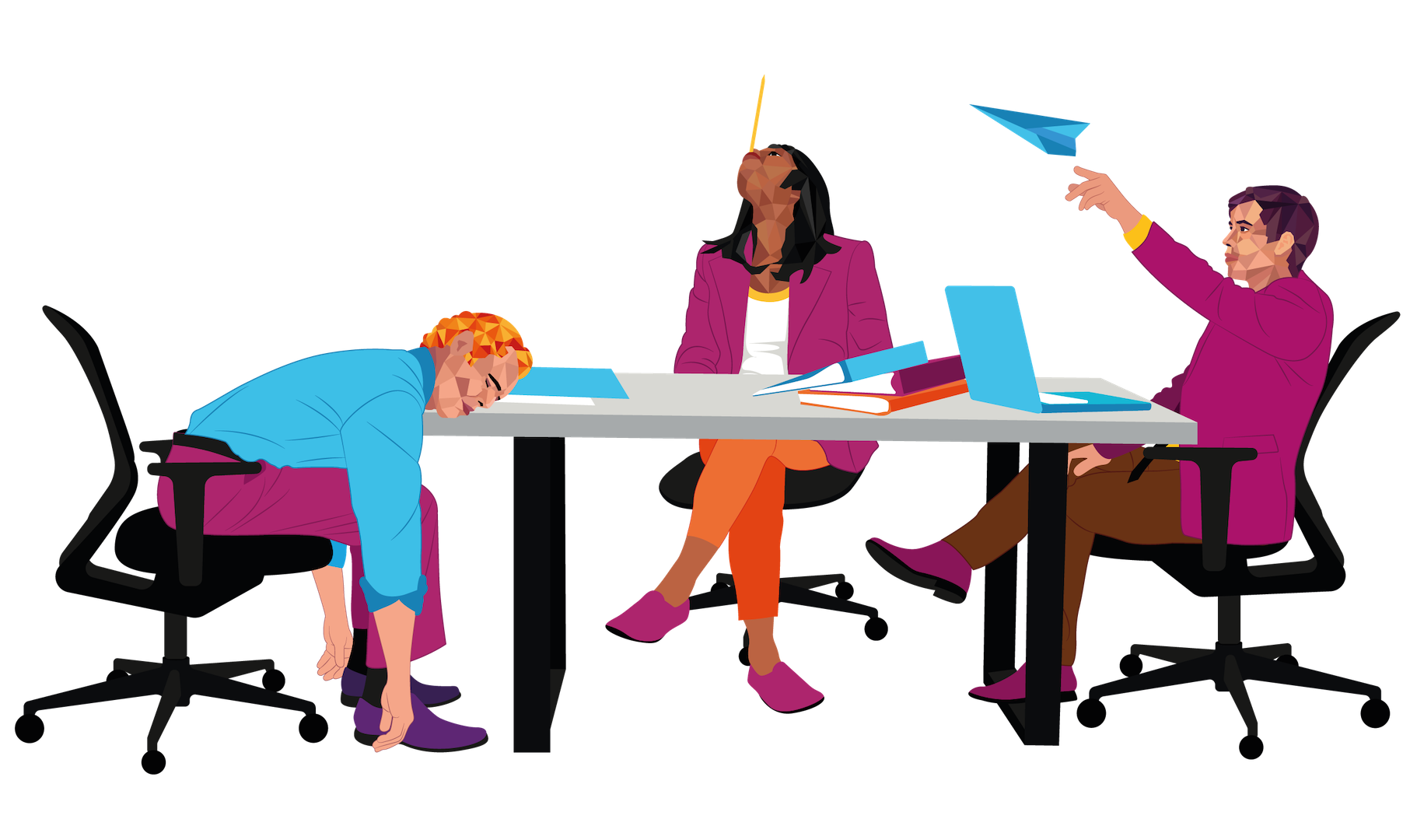
Three people in an office. One slumped in chair, one looking upward with a pen, one throwing a paper airplane.

Every month we host an Ask Me Anything forum where people bring their burning questions about meeting design or facilitation. More often than not, the questions we get can be summed up as, “Why is the meeting so boring? I feel like I’m pulling teeth trying to get people to engage. It just feels like a waste of time.” There are a lot of reasons meetings can feel like that. Here are some of the most common:


  • The agenda is too ambitious for the amount of time.
  • There is no collaboration and interactivity; it’s really just a report-out.
  • The presenters are focused on delivering information, not on engaging the group.
  • There is no clear owner or facilitator(s).
  • It’s information overload.


It can be overwhelming to tackle all the possible issues at once. If you’re in a position where it feels like everything is bad about one of your critical business meetings, start by tackling the agenda.


Why start with the agenda?


The agenda is the backbone of your meeting. It’s your roadmap. It’s your north star. Why are we waxing poetic about this? Because when crafted thoughtfully, the agenda has the power to take your meeting from zero to hero.


How do you refresh a meeting agenda?


First, clarify the desired outcomes for your meeting. Our favorite way to do this is by figuring out the Know, Feel, Do of the meeting. For a deep-dive into what that is and how to craft it, check out this downloadable guide here. If you prefer, you can also come up with a simple mission statement by completing this sentence: “The purpose of this meeting is to…” Make sure you write a complete sentence and get as specific as possible; avoid bullet points as they allow you to be vague. 


Once you have a crystal clear meeting purpose, identify conversations you need to have to achieve your desired outcomes Each of these conversations should become its own agenda item.


Then, assign each topic a relative weight with respect to  how much of the meeting you think it should take up. Consider the following:


  • Which are the most critical items,
  • Which order makes the most sense to gain buy-in over the course of the meeting, 
  • Which items can be scheduled last, and potentially dropped if time runs out. And then question whether you need those topics at all.


Use your relative weights to determine how much time you need to allocate to the meeting and each item. It’s important to be realistic here. It’s better to overestimate the amount of time you think you need, because the potential consequence is you’ll let everyone go early (something everyone loves). If you underestimate the time needed, the consequence is you won’t get through it all, and you’ll have to schedule a followup meeting (something people find frustrating)..


If you want to see what we’re talking about in more specifics, we’ve marked up two client agendas with the kind of feedback we typically give. Download them and compare them with your own agenda.


What is the worst meeting on your calendar? How would you change the agenda to give it a long-needed reset?

Summary of Takeaways

If your meetings feel like a waste of time, the problem usually starts with the agenda. A thoughtful agenda acts as your roadmap and north star, ensuring engagement and clarity. Here is how to refresh yours:


  1. Clarify the "Know, Feel, Do": Before listing topics, define your desired outcomes. What do you want participants to know, how do you want them to feel, and what should they do after the meeting? Alternatively, write a single, specific mission statement starting with: "The purpose of this meeting is to..."
  2. Turn Topics into Conversations: Don’t just list "Project X." Identify the specific conversations needed to achieve your outcomes. Each of these conversations should become its own distinct agenda item.
  3. Assign Relative Weights: Not all agenda items are created equal. Decide which are most critical and order them logically to build buy-in. Identify items that can be dropped if time runs out, and be ruthless about whether a topic even needs to be there at all.
  4. Be Realistic with Time: Overestimate how much time each conversation will take. It is far better to end early and give people time back than to rush through critical items or be forced to schedule a follow-up meeting.
  5. Focus on Facilitation, Not Just Presentation: Avoid the "report-out" trap. A good agenda shifts the focus from delivering information to guiding a group through collaborative decision-making.


The Bottom Line: A great meeting doesn't happen by accident—it’s designed. By moving away from vague bullet points and toward a goal-oriented roadmap, you turn "another meeting" into a high-value tool for your team.

Share this article

Recent Posts

By Stephanie Judd September 21, 2026
Stephanie had a mentor who went straight to ‘here’s what I would do’ the moment Stepanie asked for advice. Although this mentor was extremely well-meaning, the advice she gave was irrelevant and outside of Stephanie’s reality. “Take your clients to the ballet,” she said. But Stephanie lived nowhere near a ballet company, and her clients weren’t local to her. If this mentor had just paused to ask Stephanie a few questions, her insights would have been a lot better formulated.  Most people leading a discussion default to questions that inform them rather than explore possibilities. The difference is subtle, but the impact is huge.

By Stephanie Judd September 8, 2026
Leaders have to have all the answers, right?  Kara had a coaching client who was facing a big org change and needed to keep her people motivated. She was hyper focused on what she should say and how she’d provide her people with answers. She knew this was a critical moment for building and maintaining trust and engagement on the team. But when Kara asked, “What would you be looking for from your leader in a moment like this?” the client said, “For them to listen to me.” Then why do we try to have all the answers? Why don’t we listen?
By Stephanie Judd August 3, 2026
Letitia came to Stephanie stressed. She ran a monthly working group and every month felt the same: low attendance, low engagement, and a Q&A section that was mostly just awkward silence. She spent hours preparing a presentation nobody seemed to care about and couldn't figure out what she was doing wrong. When Stephanie asked her to walk through the format, Letitia said they do forty minutes of presentation followed by twenty minutes of Q&A. She selected the topic each month, recruited a presenter (often herself by default because no one ever volunteered), and carried the entire session on her back. Stephanie pointed out something that surprised Letitia, even though it felt obvious to her in retrospect: the format was inadvertently creating a group of observers, not active collaborators. The meeting was designed in a way that encouraged passivity.

By Stephanie Judd July 5, 2026
When we tell people that Wolf & Heron doesn't use slides in its in-person workshops, they often respond with an excited, “I love that! How refreshing!” That reaction is telling. Nobody says "that's weird." They are instantly relieved, relaxed and excited. They say refreshing — which means somewhere, on some level, they already know that slides aren't working the way they're supposed to. And in fact, workshops or presentations that rely on slides often make us sleepy. Here's the science behind why.
Show More